When enable the refraction in precession setting ,
The HA of Polaris in info does not correct the refraction
Skysafari 5 pro
When enable the refraction in precession setting ,
The HA of Polaris in info does not correct the refraction
Skysafari 5 pro

So does my Skysafari 4 plus of Android
I guess all versions have the same behavior?
That's a mistake(or bug),
The hour angle (HA) in info of object should correct the refraction of air when you enable the refraction in precession setting.

The hour angle is the difference in right ascension between the object's RA and the RA of the meridian. When expressed in hours and minutes, the HA the time elapsed since the celestial body’s last transit of the observer’s meridian.
This is not affected by refraction.
Hi Bill, thank you for your explanation,but i don't get it,
Why does the refraction not affect the hour angle of the object , when the object has different refraction from NCP?
i'm not the expert, but I just saw the article below:
Title: The Correction of Declination and Hour Angle for Atmospheric Refraction
Authors: Levin, A. E.
Journal: Memoirs of the British Astronomical Association, vol. 24, pp.18-28
http://adsabs.harvard.edu/full/1924MmBAA..24...18L
Perhaps you are confusing the "Hour Angle" with the "Position Angle" (I occasionally confuse them as well). The latter would be the angle of an object around a clock face where the NCP is the center of the clock. I agree that that would change with refraction.
Hi Bill
I believe that I'm not confusing the HA (https://en.wikipedia.org/wiki/Hour_angle) with the PA
as far as i know, the polar scope of equatorial mount is a good example of concept for using HA to find the polaris
the attached image is a ios app called "Polar Scope Align Pro"
regards,
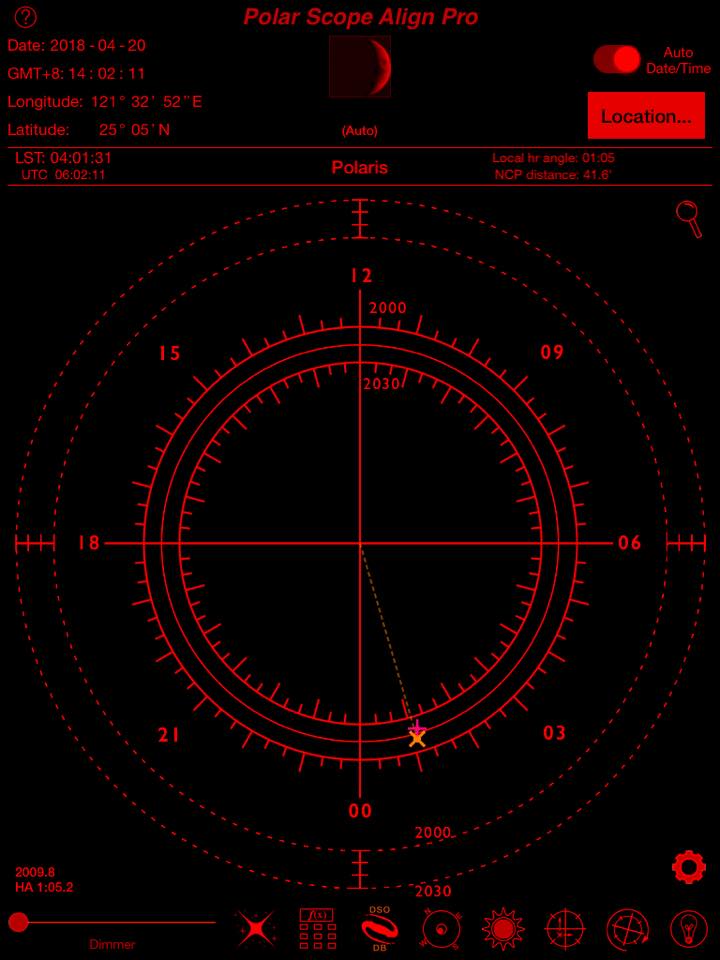
That very Wikipedia article makes it clear that refraction can't come into play here.
================================================================
The local hour angle (LHA) of an object in the observer's sky is
 (If result is negative, add 360 degrees. If result is greater than 360, subtract 360 degrees.)
where LHAobject is the local hour angle of the object, LST is the local sidereal time, 

Negative hour angles indicate the time until the next transit across the meridian; an hour angle of zero means the object is on the meridian.
================================================================
So the HA of an object is the Local Sidereal Time (RA of the meridian) - the RA of the object. The right ascension is *never* affected by refraction.
In the case of Polaris and the north celestial pole, the PA and HA are somewhat conflated. I do agree that where Polaris is placed in the Polar Scope Align app is dependent on refraction.
Hi Bill
from my understanding,
the definitions of "hour angle" is “the angular distance along the celestial equator from the observer's meridian to the hour circle of a given celestial body”
the "LST- Object RA" equation holds only when there's no correction required.
Regards.
I'm sorry, I didn't have time to argue this point any longer. We stand by our belief that HA is independent of refraction.