New post
0

How Can I Confirm The Accuracy Of The Model Used To Define The Polar Axis? (Answer: Cross-Reference With Multiple Sources)

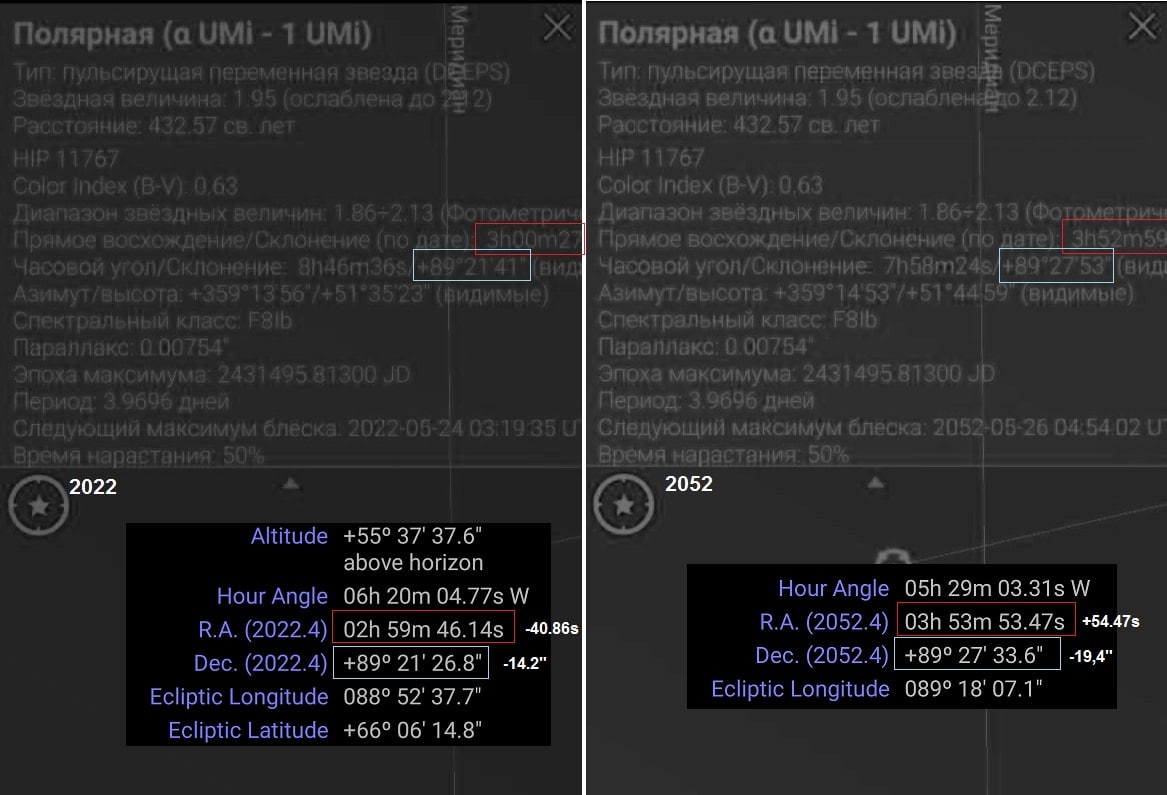
To realize one promising adjacent problem (self-manufacture of a grid for a pole finder), I need the exact coordinates of the Polar Star. I decided to use data from Sky Safari 6.8.6.15 Pro. A friend has a Stellarium. I asked to see the coordinates of this star for different eras (today in 2022 and in 30 years at 2052). Found that the coordinates do not match for the same time and differ by several tens of seconds. As a result, I doubt that the correct model of the sky and celestial equatorial coordinates was chosen for both programs. What do you take and from what sources? How is precession calculated? I bring a screenshot. Above the coordinates of Stellarium, and below - SkySafari and differences. What can I believe?
3 comments

  • 0
    Avatar
    Michael Grehov

    There has been no response from developers for more than a month. Sad. Can you appoint several moderators for community?

  • 0
    Avatar
    Keiron Smith

    Michael, 

    From the SkySafari Help guide:

    The settings in this view let you set the precession epoch of the Equatorial coordinate system that SkySafari uses to report the right ascensions and declinations of objects. It also gives you precise control over the corrections SkySafari makes when computing the positions of objects in the sky.

    Precession & Nutation

    Precession is a very slow "wobble" in the direction of the Earth's rotational axis, which takes about 25,800 years to complete. The Earth's axis defines both the Equatorial (or RA-Dec) coordinate system. Because of precession, an object's right ascension and declination change over time - not because the object is moving, but because the coordinate system is moving.

    Use Current Epoch: if turned on, SkySafari will always report right ascensions and declinations for the current year ("epoch"). If turned off, SkySafari will report RA and Dec for the precession epoch entered below.

    Precession Epoch: the precession epoch (or year) for which equatorial coordinates should be reported, if "Use Current Epoch" is turned off. Star atlases and ephemeris predictions (e.g. as in the Astronomical Almanac) often use a fixed epoch, such as 2000.0, for reporting RA and Dec.

    Include Nutation: a small wobble in the orientation of the Earth's axis superimposed on its overall precessional motion. Nutation causes a small change in an object's position, typically amounting to about 8-10 arc seconds.

  • 0
    Avatar
    Keiron Smith

    Unfortunately, we can not give you the source for the code at this time.

    But, it is fair to say, you can and will find discrepancies between different apps and websites and, so, if accuracy if of paramount concern for your research, it would be wise to consult multiple 3rd party authoritative resources, i.e, also see NASA data - and work towards a conclusion from there.

    Thanks!

Please sign in to leave a comment.