Presently SkySafari turns off the horizon when the user selects equatorial coordinates. I would like to have control over that option giving me the ability to switch the horizon on when using equatorial coordinates.
Date
Votes
12 comments
-

Keiron Smith Official comment DevOps reference: https://starrynight.unfuddle.com/a#/projects/7965/tickets/by_number/1898
-

Bill Tschumy May I ask why you want that? I really can't see any reason people would want the horizon cocked at strange angles if we allowed this. What are you trying to accomplish? Starry Night allows this and this is what you get.
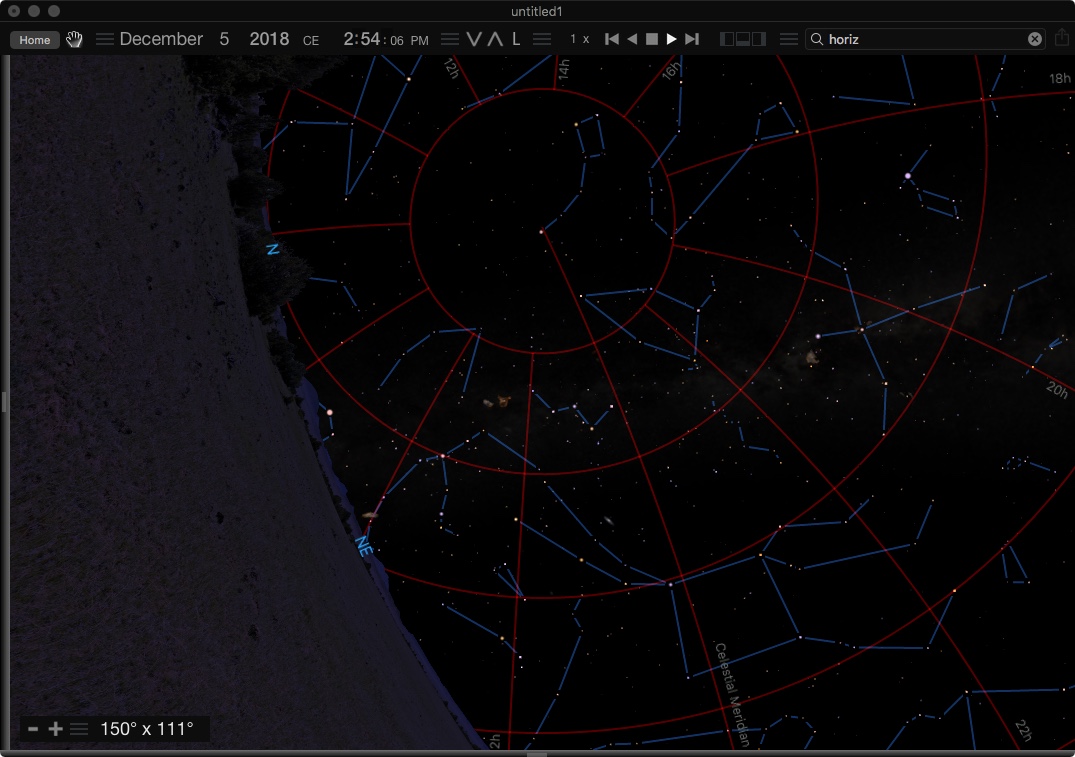
-

Gary Carter I do not use Alt/Az coordinates to observe. I do want to see the horizon and do not view this as "the horizon cocked at odd angles". Having a solid background in 3D modeling, my mind's eye isn't bound by Earth's gravity. Earth is simply an obstacle to the FOV. Seeing its relative position helps me comprehend what targets are above and below the horizon. In my opinion this would be a very useful feature for those of us who use push-to mounts and the equatorial coordinate system. And as you know I am not alone in this opine.
-

Corey Rueckheim I want to clarify the Horizon Coordinate System vs. the Equatorial Coordinate System problem that I've read some heated opinions about online. This has come to my attention because of my own frustrations with SkySafari Pro limiting me from doing what I want it to do. I will try to keep my own emotions in check in spite of my own frustrations, though I am sure I will slip a bit. :)
From what I've read, it seems the decision to not allow a horizon to be visible when viewing the sky using equatorial coordinates is because you want to make sure that the average user won't end up getting confused when they toy with options they may not understand, and therefore can't get the horizon to sit correctly. However, there is at least one very important use for being able to see the horizon in equatorial mode. (To visualize what I'm trying to say, please take a look at Stellarium, which has a little "telescope" icon that you can click to toggle equatorial mode on and off and which doesn't affect the horizon).
All star charts use equatorial coordinates. All of the constellations and star patterns that I've memorized over the course of my life are memorized with north celestial pole "up". So as I explore the sky using SkySafari Pro, looking for targets, browsing, or whatever I feel like doing, I very much prefer to move around using the equatorial mode. I have little doubt that most serious amateur astronomers have the same preference (see other people's posts for support of this). Horizon mode is useful when I want to see the "big picture", but when moving around the sky in this move, the patterns I've memorized twist and turn in all sorts of odd directions depending on what part of the sky I am looking towards (especially near the zenith), and this can really be quite annoying! However, SkySafari forces us to use horizon coordinate mode if we want to be able to know where the horizon line is. Sure, I can switch back and forth if needed, but that is an unnecessary nuisance. When scrolling around the sky looking for observing targets using the comfortable equatorial coordinate system, it would be VERY handy (dare I say even IMPORTANT) to have a reference as to where the horizon is so I don't waste time accidentally wandering out of the visible sky. Not having this reference frame is a nuisance, all the more annoying because it has apparently been done on purpose. It would just be so much easier and less annoying if the horizon was simply there, where its supposed to be when using equatorial mode.
I really have a difficult time understanding why you want to limit amateur astronomers like this, to make browsing the sky more difficult than it needs to be. I suspect it is because coordinate systems can be confusing, and trying to explain to you what is wrong can be even more confusing for us! So I suspect the reason so many people have gotten emotional about this topic is because they are trying their best to explain what I have just explained (hopefully with clarity) but have been unable to make the problem clear to you. Well, now that I have (hopefully) laid the problem bare, can't you please fix it? A horizon in equatorial mode is a sorely needed feature for many amateur astronomers like me. Its a shame that this feature is missing, as SkySafari Pro is absolutely awesome otherwise!
It is also annoying that SkySafari defaults to horizon view every time I start it up. Couldn't you set it so that it remembers which coordinate system we used last, or let us choose the default startup coordinate mode?
Also, and this is perhaps a minor thing to most people, but there is another handy reason to have a horizon in equatorial mode. In equatorial mode, you get to see what your equatorially mounted telescope sees. And the telescope and any camera on it can definitely see the horizon. So when trying to better comprehend how to use an equatorial mount, the horizon can be pretty useful for visualization purposes. Again, the lack of a horizon, and therefore the lack of a frame of reference as to where the telescope is actually pointing is pretty annoying. (Go to Stellarium and click the little telescope icon to switch into equatorial mode and then pretend that you are an equatorially mounted telescope. and you will see what I mean!)
If you really feel that its necessary, perhaps you can find a way to allow this while limiting novice confusion? I don't think this is really necessary though. There seems to be less concern about Stellarium users getting confused by a horizon in equatorial mode then I've heard from users of SkySafari being confused as to why there is no horizon in equatorial mode! I think you may be underestimating your customers' abilities, at many amateur astronomers' expense. This is, after all, SkySafari "Pro", not SkySafari "Novice". If really necessary, couldn't you have an "Advanced" menu that sternly warns "Here Be Dragons" or something that gives us access to features you feel are overly advanced?
FEATURE REQUEST: Your reference lines, like the horizon, ecliptic, galactic equator, etc., would benefit from having optional coordinate tick marks along them, separate from the grid selection options. With this, we could find, for example, where a specific ecliptic longitude (displayed using the optional tick marks) crosses an equatorial latitude (displayed using the optional grid).
Anyway, back to the issue at hand. Another problem is that the view coordinate system and the displayed coordinates are locked together and cannot be chosen separately. When I move around the sky, even in horizon mode, I want to see what RA/Dec I'm pointing at, not Alt/Az. Honestly, alt/az coordinates are mostly useless to me, and I suspect, to many serious amateur astronomers. And for that matter, what would be the harm in letting us explore the sky in equatorial mode while we view the Alt/Az? That would actually be very handy!
In one particular case, in fact the reason I am writing this essay, is that I wanted to investigate local sidereal time, which is the RA coordinate that is crossing the meridian at any given moment. I feel like I should be able to display the meridian on the screen, turn due south, and watch as the RA of the sky at the meridian increases as the Earth spins. However, in the horizon coordinate system, I can only see alt/az coordinates, and while in equatorial mode I can't see the horizon or the meridian and therefore can't find south! Either way I cannot achieve the desired result, not because SkySafari Pro is necessarily incapable of it, but because it has been purposefully limited in order to prevent us from being able to do this. In the end, the only option is to click an object near the horizon, look up its info, and read the RA off of there. (Note: Stellarium fails at this task too, because it doesn't display the coordinates of the center of view at all!) I'm not sure what program I would use to teach my son about this concept, but it sure would be nice if I could do this with SkySafari!
BUG ALERT: To rub salt in the wound, there is some strange behavior in horizon view: The view is supposed to be locked to the horizon with the stars slowly moving toward the west. However, if you zoom in with time progression set to real-time, the stars do not move with respect to the horizon! Worse still, if you turn on the meridian, which should remain locked to the horizon, the meridian moves toward the east, along the horizon! If you increase the time progression rate at all, this problem seems to go away and the meridian stays put and the stars move west as expected. To see this issue for yourself, make sure you are in horizon mode, turn on the horizon and the meridian, and zoom in at the location where the meridian and the horizon meet.
Also, as a final note, it is just plain annoying to have the horizon disappear every time I switch to the equatorial coordinate system. Please add the horizon!
Thanks for listening!
-
Bill Tschumy Corey,
Thanks for your thoughtful request. The lead developer on SkySafari has felt very strongly on the issue of only showing the horizon when in Horizon Coordinates. However, I will make sure he sees your arguments and the team can discuss it. The only way I can see us doing this is to add another setting in the Coordinates Settings for whether you want the horizon displayed in non-horizon coordinates. The default would be OFF.
We can also consider adding an option for tick marks on the grid (Uggh, more options)
It is also annoying that SkySafari defaults to horizon view every time I start it up. Couldn't you set it so that it remembers which coordinate system we used last, or let us choose the default startup coordinate mode?
I'm not sure why you are seeing this. SkySafari does remember what mode you are in. I just verified this on all 3 platforms. All your settings and the specific chart view (FOV and chart center) should be remembered. Are you sure about this?
BUG ALERT:
This is not a bug. We designed it that way. When you are zoomed into a small field of view (less than 15 arcseconds per pixel) we keep the stars in the same position on the chart as time flows. Think of it like having a tracking scope. We didn't want the object being looked at to drift out of the FOV when zoomed way in.
-
Corey Rueckheim Bill,
Thank you for your quick and helpful response! I checked and confirmed that the coordinate system is indeed remembered correctly between sessions. I must have become confused with all the switching back and forth between horizon and equatorial modes.Thank you for listening, and for all your work on my favorite astronomy app!
-
Bill Tschumy I talked with Tim about adding an option to display the horizon in equatorial mode (or any of the non-horizon modes). He seems willing to go with this. I will try to get it rolled into a future release soon.
-

safinsd I agree with Corey. I'm switching from Stellarium to Sky Safari 6 Pro and am dismayed by the inability to see a horizon line with an equatorial grid. It's extraordinarily helpful while tracking an object through the night sky and advancing time - all the while seeing where the object is relative to the horizon so I know it's in view. It may be a deal breaker.
-
Gary Carter So many years have passed and this feature, desired by serious astronomers, is still missing. Sigh….
-
Keiron Smith I will ask developers to review again this request.
Thanks for the reminder!
-
Gary Carter Thanks Keiron! This would be a great improvement for those of us who prefer the use of the equatorial coordinate system with the ability to show the horizon. The debate over enabling this feature has puzzled me for many years. I hope the argument against this is finally coming to a close.
-
Keiron Smith I'm not making any promises. Developers will make the final decision about whether this will be implemented. I will make sure the query is, at least, top of mind in the near future.
Thanks!
Please sign in to leave a comment.