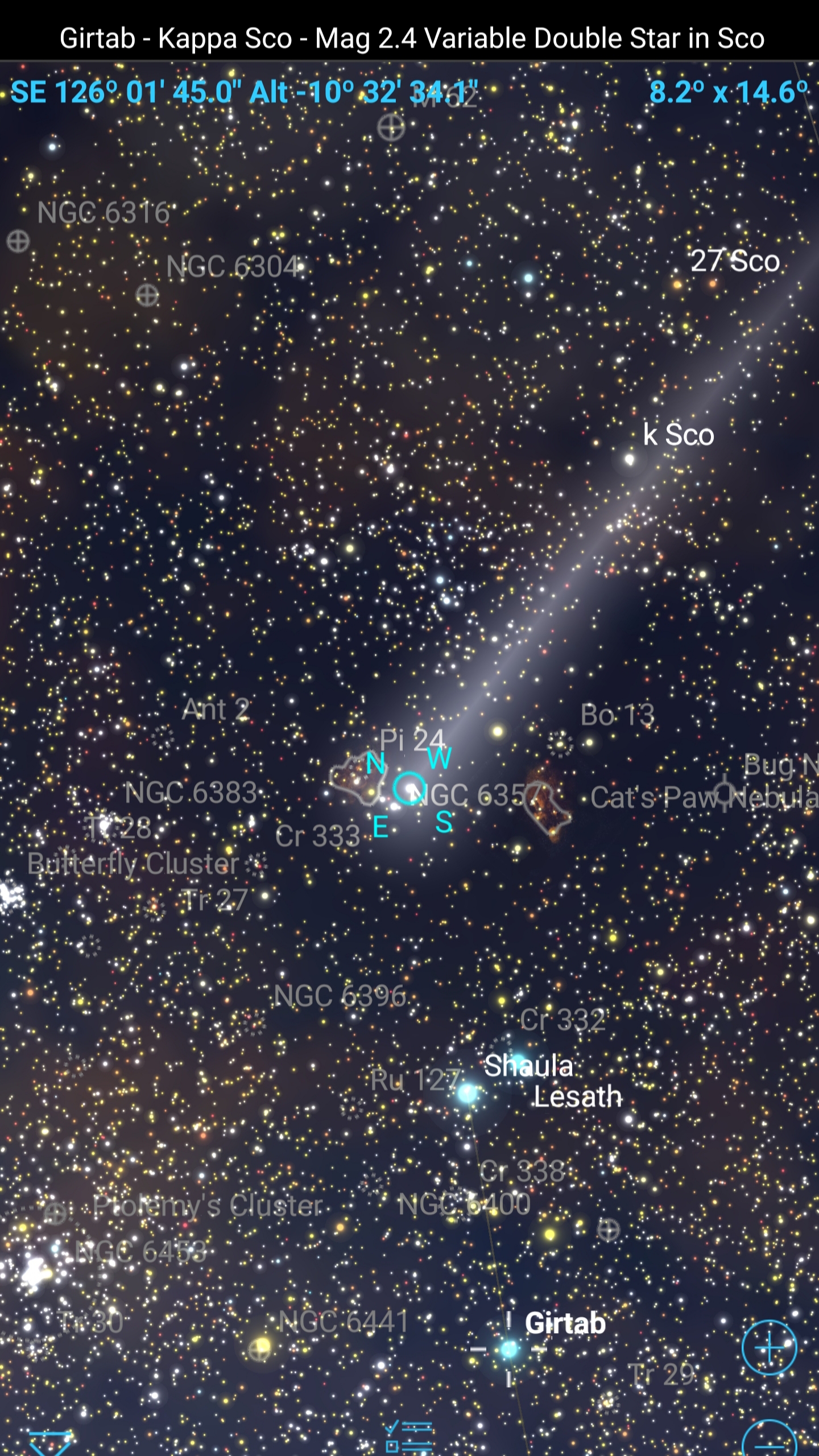
On opening SS6 Plus this evening I'm confronted with the following screen:
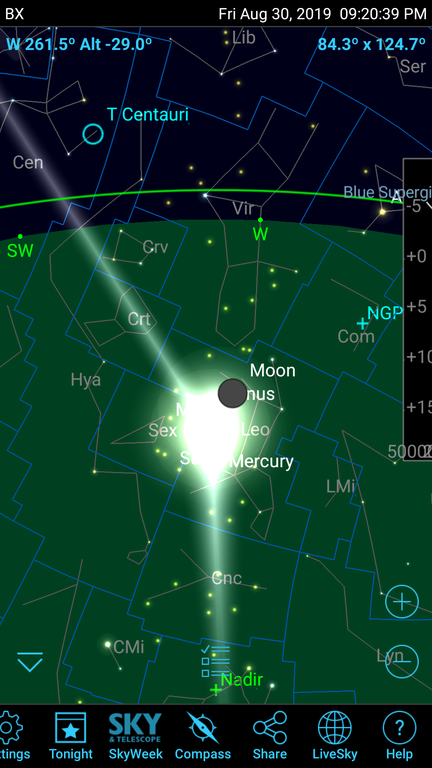
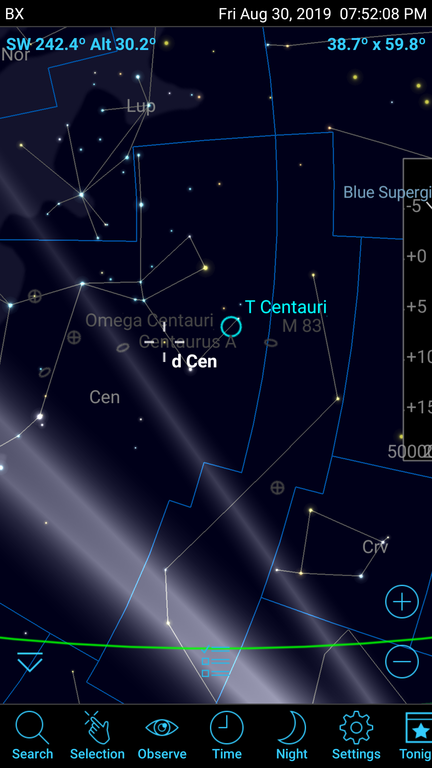
Some horrible flare(?) coming out of the sun and showing up through most of the sky, regardless of the day or night side.
Can anyone shed some light on this, please?
On opening SS6 Plus this evening I'm confronted with the following screen:
Some horrible flare(?) coming out of the sun and showing up through most of the sky, regardless of the day or night side.
Can anyone shed some light on this, please?

In time, I switched my phone off and on again and it still persists. Also even my old SS4 Pro is showing the same thing.

Mine is doing this too. Looks like a bug on this date for the sun, very strange.
It definitely has all the tell-tale signs of a big, fat untimely bug.

Nope, not a bug at all. It's how SS displays comets!
Indeed, it's showing two comets these mornings.
P/1999 R1 (SOHO)
and
322P/ SOHO
If you tap around the Sun, you'll eventually see the comets identified.
What is weird, though, is that those are comets that, as far as the descriptions go, orbit between Mars and Jupiter and so shouldn't be showing tails at all.
Adding to the oddity, when one pans the sky even slightly in azimuth, the tails change their direction greatly. That's just not right!
I initially thought maybe it was a comet as well, but upon zooming in, it was so bright I couldn't even see them. These would have to be mag -35 comets or something based on how they're displaying, with tails spanning across the entire sky. :)
I figured they were comets before reading your reply (they definitely are so, as you can go to the Bright Comets list, pick, say, the brightest ATM (322P/SOHO), then, when when you center on it and zoom in, it definitely points straight to its nucleus.
Bug or no bug, and until a developer chimes in, the solution I found is disabling comets altogether under the Solar System settings options.

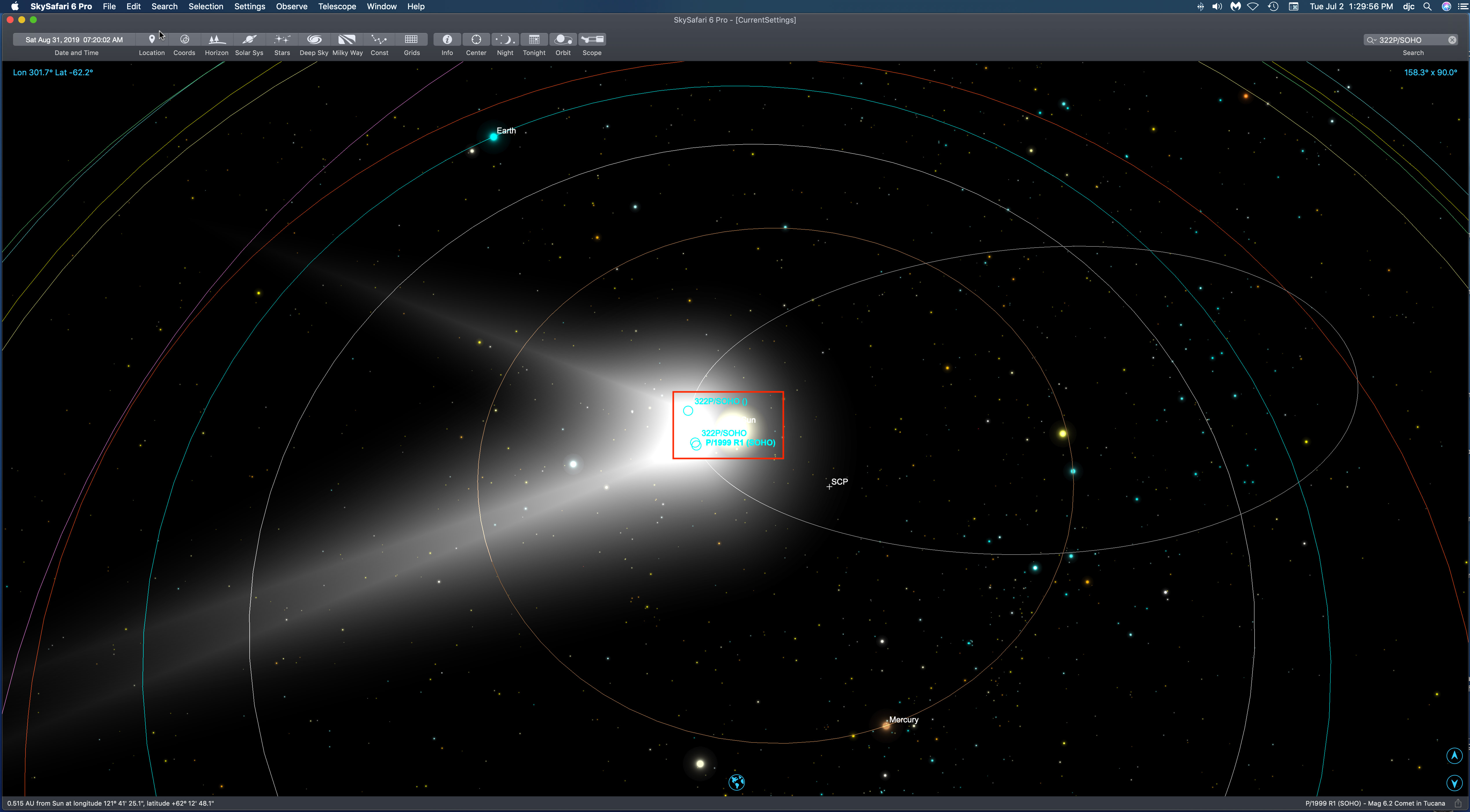
There are actually three comets being plotted almost on top of each other.
322P/SOHO ()
322P/SOHO
P/1999 R1 (SOHO)
Perhaps all three are actually the same comet but with slightly different orbital data. If so then this is the first bug.
When the tails are plotted on top of each other the effect is multiplied greatly (a bug in my opinion).
Additionally when any comets are at perihelion their tails are not displayed correctly. When at perihelion the tail's position will vary wildly depending on the panning of the display (another obvious bug). Before and after perihelion the tail's position remains constant while panning.
These problems also exist in the iOS and Mac versions.
View the animation:
Not wanting to rush things in (perhaps just a little bit) but my lack of experience within this forum compels me to ask: Does this kind of bug report get the attention it deserves from the developers and, if positive, how long does it usually take them to acknowledge them?
In all fairness, we have just come out of a three day holiday weekend, so I would expect a bit of a delay.
That being said, support has definitely slowed down lately. I think Keiron is doing it all now. I haven't seen a post from developer Bill Tschumy since July 29. I hope he (and Tim DeBenedictis) are still SkySafari developers.

Hey all,
Sorry for the delay getting back to you on this. As you've all determined, this is a problem with the comets data. It's not a "bug" per-se... the app is correctly displaying the data being provided to it, it's just receiving bad data. We're going to look into exactly why that comet is coming through 3 times, and why the magnitude is off.
For the record, Bill Tschumy retired! He'd been doing this for a long time, and has decided to take time for himself, for his observing, and for other fun projects.
Tim DeBenedictis hasn't truly worked here for over a year. He's been on some special projects for us and remains a friend of the company, but has decided to try other things.
Ros Hartigan and I have taken over full-time development of the SkySafari apps (we've been working on them for two years now) and will continue to pop our heads in here (and CloudyNights) when our first line of defence (Keiron and Matt) need backup answering your questions.
Hope that clears a few things up. We'll have a look at this problem.
- Dave Whipps
Hey Dave
Thanks for the update, as I didn't know Bill had retired. Do you and Ros plan to continue developing SS for Android, adding features and eventually creating SS7? Really curious in your outlook on the future.
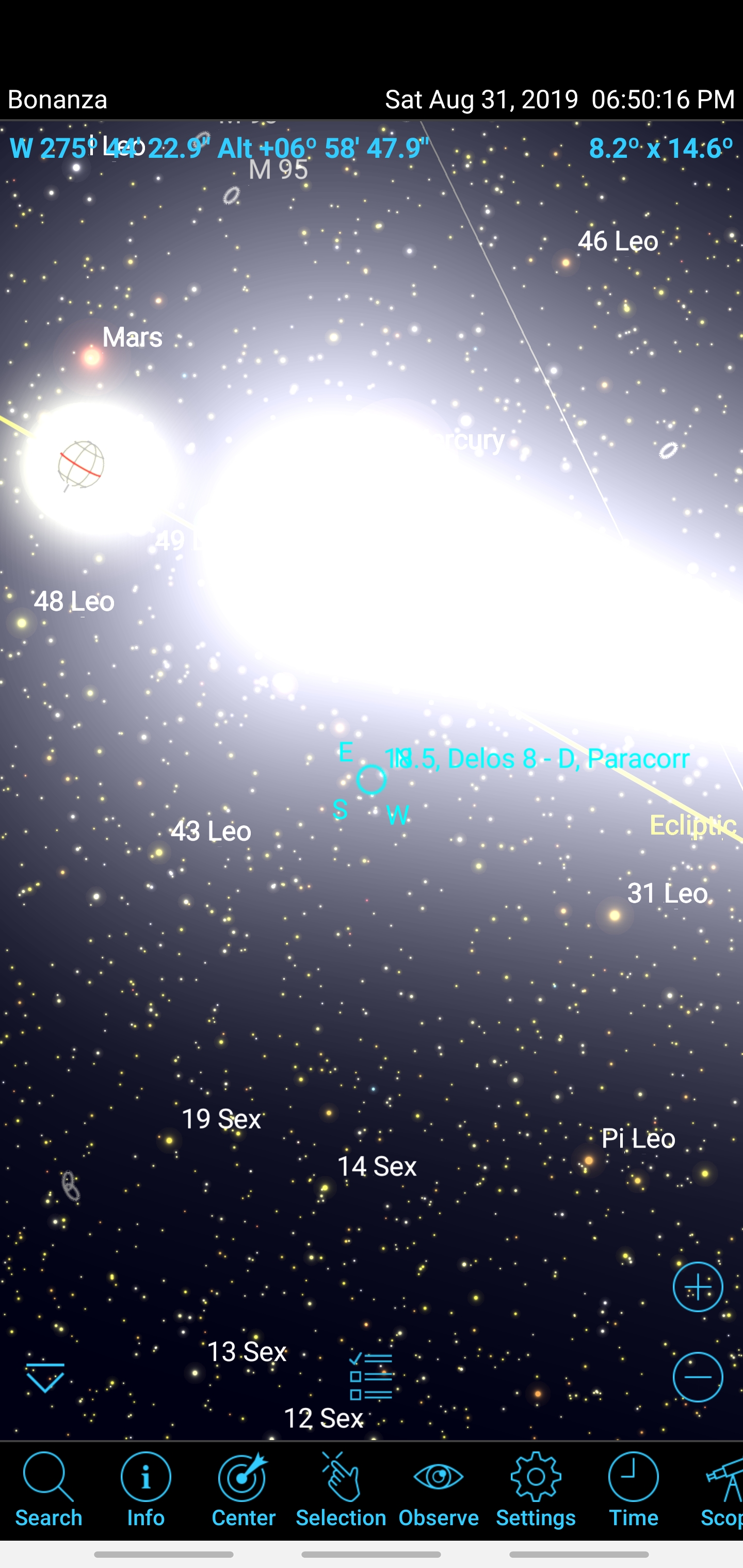
As for the comet display issue being discussed here, I see a couple comets in the below picture in the mag 7-9 range. These seem drastically brighter than the sun, which seems very strange to me. Another screen shot is of Comet Halley at mag 6.2 and it looks quite different. Are the comets displaying at magnitudes not shown in their data?

Is anyone encountering this issue on iOS? Or, is everyone here just on Android?
As I said in my earlier post, these problems exist in all platforms, Android, iOS, and Mac OS.
And don't forget that there are three separate issues described here. Please address all of them.
I can confirm that the comets show up with the long, bright tails on the iPad, iPhone, and iPod Touch 6G.
I can also confirm that the tails change their positions wildly as one pans around the sky -- which is definitely a bug.
That same problem happens with well-known periodic comets that do come close to the Earth and the Sun and sport actual tails. The tails' positions shift direction greatly as one pans the sky!
One update to my original post above: While the info not he comets indicates they orbit between Mars and Jupiter (indeed at a distance roughly comparable to mail belt asteroids), that's for their AVERAGE distance. At least one of these comets (if not all) do approach nearer the Sun than that -- but I believe these are dead husks of comets and do not sport tails at all -- and certainly not such long, bright ones!
Hope that helps!
----
One other thing. Great to hear from Dave -- and I wish both you and Ron continued success in developing Sky Safari! It's a beloved program, with incredible ease of use and a rich panoply of features. Bill's retirement is well deserved. His presence at Cloudy Nights has been a big help -- and there is lots of discussion about Sky Safari over there, so it's good to think you and Ron will show up there every now and then!
Hey all,
I think we've confirmed that it's just a (poor) drawing of comet 322P when it's closest to the Sun. Can any / all of you confirm that you only see this when setting your date to between about August 28 and Sept. 2nd?
Also, Dean mentioned that there are "three separate issues" here, but not clear on what the other two are. Dean, can you enumerate them so that we can fix?
Thanks to everyone for your diligence. We'll get this (and any other issues you identify) in a future update.
Also, Larry, it's "Ros," short for "Rosalind." She's the other developer working here, and helping keep things ship-shape.
- Dave
Dave,
To answer your question:
Issue #1: The existence of three comets with almost identical orbits.
322P/SOHO ()
322P/SOHO
P/1999 R1 (SOHO)
These may be the same object with three different names, or actual fragments of what once was a single object. If they are all the same object being plotted three times, then it is an issue. But if they are all legitimate separate objects then it is not actually an issue.
Issue #2: The problem of superimposed comets displaying an overly increased brightness far beyond what would be expected. In the case of these three comets the effect was so exaggerated that it was mistaken as flares from the sun. I would say that the algorithm for comet brightness, when two or more comets are in close proximity, needs modification.
Issue #3: The position (or direction, if that term is more correct) of comet tails (as displayed against the background stars) at or near perihelion will change as the user pans the sky display. This is only noticeable for sungrazing comets. The closer it is at perihelion, the more exaggerated the effect. At its worst, both direction and intensity can change while panning.
Please view this animated gif file:
http://www.whenpigsflyetc.com/gallery/Comet_tails.gif
As the OP, I'm glad this is due for some debugging. Having followed SS development since the early days, I was sure it would be tended to from the beginning.
Great to know that rather frustrating night (I was already having difficulties with polar alignment... then everything clouded over soon after on top of those "searchlight-like" comet tails) is gonna pay off in the end.
Big thanks in advance!
Scott. I hope that you're right.
So far I have seen no comment from the developers to indicate whether or not they intend to fix any of this.
We have certainly given them sufficient information to reproduce and analyze the problems.
Dean,
I am the developer, and if you read above, we've both explained the cause of the problem, and indicated that we will fix this (only one, as far as I can tell) problem.
- Dave
It will do this in ~August every 4 years. I confirmed 2023, 2027, 2031.
Would still love to hear a response on this:
Do you and Ros plan to continue developing SS for Android, adding features and eventually creating SS7? Really curious in your outlook on the future.
Thanks
Chris
Chris
Dave,
Sorry, I missed seeing the sentence where you stated that you would get this in a future update.
However, I believe that you may be incorrect in your assumption that this is "just a (poor) drawing of comet 322P when it's closest to the Sun". I believe that there is a more extensive issue affecting more than just 322P.
This "flaring" occurs with every sun-grazing comet that I have tried so far. At some point near perihelion, both the comet and the sun's image will brighten unnaturally. At the most exaggerated point, SkySafari also loses the ability to correctly display the proper direction of the comet's tail. This can be demonstrated by stopping the clock at this point and panning the sky around the comet (moving the comet to the top and bottom, left and right, on the screen). The comet tail will swing wildly around, and sometimes also abruptly change intensity.
The following comets also exhibit this behavior when setting the time to the accompanying Julian dates:
C/1965 S1 (Ikeya-Seki)
Julian Date: 2439054.626563
C/1979 Q1 (SOLWIND)
Julian Date: 2444116.441840
C/1882 R1-A (Great September comet)
Julian Date: 2408706.166146
C/2011 W3 (Lovejoy)
Julian Date: 2455911.161979
Additionally, there is still the issue of why SkySafari is displaying three instances of comet 322P/SOHO.
P/1999 R1 (SOHO) appears to be an alternate name for the same comet, and 322P/SOHO () -with the empty parentheses- seems to be just wrong.
And the other issue of superimposed comets displaying an overly increased brightness, might not be an accurate description, since I have not been able to reproduce this with any other comets other than the 322P group. Although, as described above, the brightness of both the comet and the Sun increase when in close proximity to each other, causing the flaring.
I hope you can take the time to fully examine these issues.
Another example of a comet tail's direction swinging around as you pan the sky display:
P/2008 Y12 (SOHO)
Julian Date: 2458765.393796
See screen capture here:
http://www.whenpigsflyetc.com/gallery/Comet_P_2008_Y12_(SOHO).gif
Ros and Dave, egg on my face!
Sorry for missing the spelling and gender on Ros.
In any case, appreciate that you both are on the case!
In addition to Dean's detailed review of what seems to be wrong with comet display, I'll reiterate my point made earlier that the comet tails shift dramatically as one pans the sky -- which is not what happens in real life! The tail is a certain length, points in a certain direction. If one slides the display somewhat farther North or South, the tail shouldn't and doesn't wildly change directions from pointing to the left or right when it was pointing the other direction before.
In other words, the drawing of the tails misbehaves as one pans the sky display. I hope I've explained that well enough. It's quite obvious if you look at any of the comets producing these long, wild, bright tails and brightened Sun!
Additional information about the comets that appear twice, once with a normal looking name, and a second time with the same name followed by empty parentheses ().
There appear to be many of these oddly named comets. I found that most of the comets beginning with 300P and ending with 380P had an empty parentheses () duplicate. Oddly, the last five comets (376P through 308P) were only listed in their empty parentheses form.
At this point I don't know if there are other series of comets that may also have this issue.
Perhaps one of the two comet names has stale orbital parameters. I seem to recall Tim or Bill commenting a while back that there were some objects who's orbital parameters were hard coded into SkySafari, and were only refreshed during certain SkySafari upgrades or updates.
Here is a partial listing of what I found:
300P/Catalina
300P/Catalina ()
*
through
*
320P/McNaught
320P/McNaught ()
321P/SOHO
321P/SOHO ()
322P/SOHO
322P/SOHO ()
323P/SOHO
323P/SOHO ()
324P/La Sagra
324P/La Sagra ()
325P/Yang-Gao
325P/Yang-Gao ()
326P/Hill
326P/Hill ()
327P/Van Ness
327P/Van Ness ()
328P/LONEOS-Tucker
328P/LONEOS-Tucker ()
*
through
*
361P/Spacewatch
361P/Spacewatch ()
362P/ [this is an anomaly. It has no name after slash. Has no second entry with ()]
363P/Lemmon
363P/Lemmon ()
*
through
*
375P/Hill
375P/Hill ()
From this point on, the comets are entered only once, but with the empty parentheses ().
376P/LONEOS ()
377P/Scotti ()
378P/McNaught ()
379P/Spacewatch ()
380P/PANSTARRS ()
Entries stop at 380P
More than two months having passed, I wonder if there has been any progress in this.

.gif)